
Lake County Active Warrants Explained
The official public channel for Lake County active warrants is the sheriff's own tool. The Lake County Sheriff publishes it, and the word "active" on that page is simply its label for the public, not a status pulled from some complete Indiana registry. Records inside the database can tie to criminal or civil proceedings, so before deciding what kind of order you are looking at, identify the issuing court and the case. That step matters because warrants carry different statuses. Issued, served, executed, recalled, quashed, and closed all describe separate events. A warrant stays enforceable until the court or authorized process changes it. Only the current court file can answer that for a particular case.
Lake County Warrant Data Transfer Lag
Timing is the weak spot of any Lake County warrant lookup. The sheriff says the data is updated frequently, and in the same notice warns that technical transfer issues can leave information incomplete or out of date. Both statements are true at once. A freshly issued order may not show up yet, and a warrant already served or recalled may still sit on the screen until the systems trade notes. That lag cuts both ways. Call the Warrant Division at (219) 755-3057 for status or corrections, then go to the issuing court. The division takes warrant information and tip calls around the clock. It cannot recall a judge's order or change bond. When two systems disagree, keep the name, cause number, court, and date of the search.
How Lake County Tracks Active Warrants
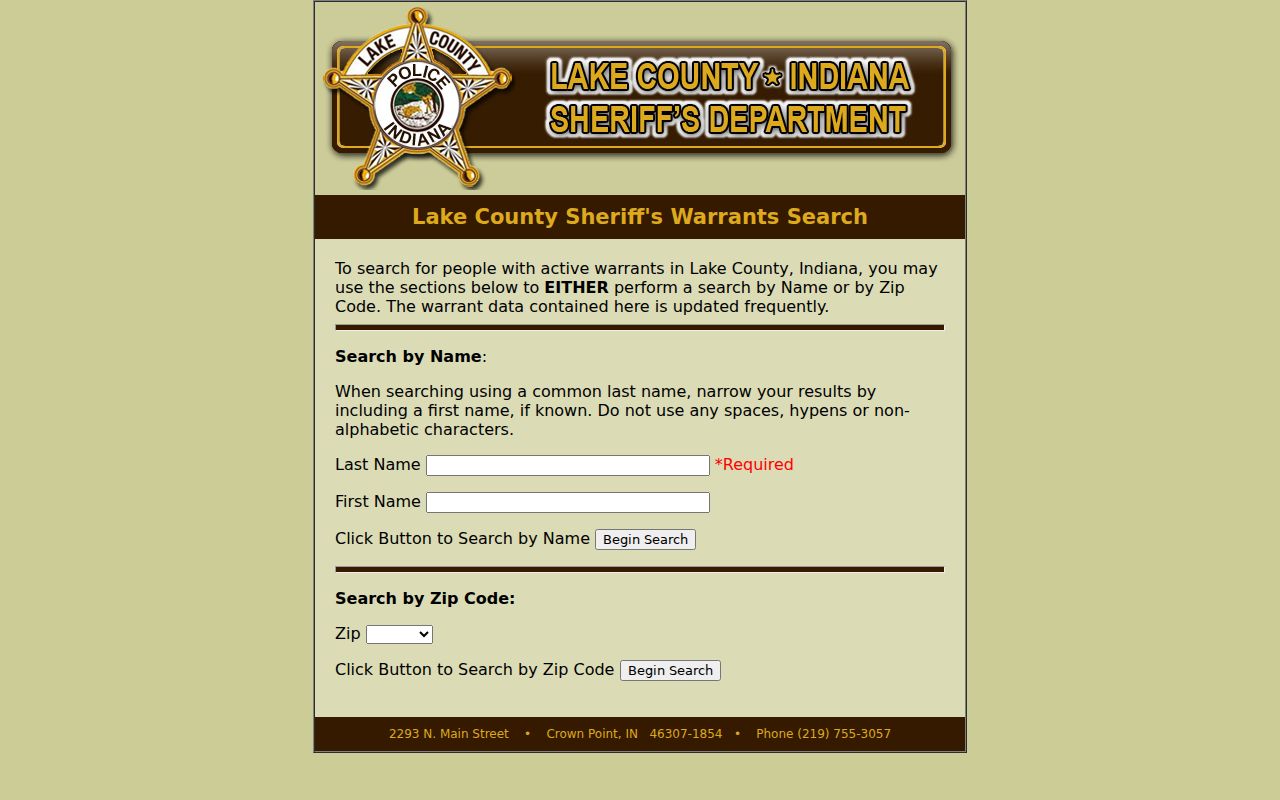
The Lake County search runs on a last name, an optional first name, or the sheriff's zip-code dropdown. Results come back with a spare header: Name, Age, Race, Sex, and View Details. Those fields can narrow a possible match, but they will not give you the full charge, court, bond, warrant date, or disposition. With common names, only the court can verify what the entry means.
Note: Technical lag can omit a new warrant or leave a changed record visible, so one search never settles current status.
The official results interface can be reviewed without reproducing any private person’s entry.
Those columns reinforce why the issuing court must supply the case and status context.
Lake County Active Checks Are Not Statewide
Indiana keeps no single complete public criminal-warrant database. MyCase is a statewide case index, not an official warrant roster, and IDACS and NCIC stay restricted to law enforcement. A Lake County sheriff search cannot settle a federal question, a neighboring county, sealed records, juvenile matters, or every municipal court. So widen the net in steps. Search the party, cause number, or citation in MyCase and read the chronological events. Then ask the Lake Circuit/Superior Court clerk, or the relevant city or town court, to confirm the controlling entry. Federal matters go through the Northern District of Indiana, PACER, and federal agency routes.
Inside an Active Warrant Record
A solid Lake County warrant check goes past the sheriff header into the official case. Read the court identifier and case type first, before the demographic fields. A Lake cause number starting with 45G points to a county criminal division, while 45H and 45I mark city and town court families. The suffix may carry CM for misdemeanor or IF for infraction. Neither code by itself proves an active warrant.
| Cause Number | A court-routing code such as 45I01, not proof of status by itself. |
|---|---|
| Name and Age | Limited sheriff matching fields that can be stale or identify the wrong person. |
| Issuing Court | The venue that controls appearance, recall, and current docket status. |
| Bond Amount | Must be confirmed from the current court order; it is not shown in the safe header. |
| Status | Verify issued, served, recalled, quashed, or other exact docket language. |
Lake County Hammond Outstanding Warrants
Hammond still shows a city-court warrant form through its official vendor, with name, date-of-birth, and case-number fields. The catch is that Ordinance 9454 shut down Hammond City Court operations after 2019, and the Lake County Clerk explains that old infractions and ordinance matters were converted or routed among county divisions. Some older CM, PL, and CC files sit in storage or come back on different schedules. So treat a vendor match as a routing clue, nothing more. Take the exact cause number and ask whether the record now belongs with the Hammond clerk or violations bureau, Lake County Division 4, another county division, or an archived branch file. Do not travel or pay until the current custodian confirms the venue.
Warrant Roundups and Most-Wanted Lists
The sheriff home page links an official Lake County Most Wanted presentation. It is a selected public-information layer, not the full active-warrant search. No Lake County office publishes a set schedule, reward list, or recurring roundup and amnesty calendar, so do not read one into the list. A blank spot on it does not mean no warrant exists.
Key Point: View the official sheriff source; this civic reference never republishes its names, photographs, or roster.
Do not contact, confront, follow, or harass a listed person. Give urgent information to 911 and other information to the Warrant Division.
Lake County Traffic Warrant FTA Check
Miss a Lake County traffic court date and two questions follow: whether the court issued a warrant, and whether it sent a suspension notice to the Indiana Bureau of Motor Vehicles. County Division 2 warns that a traffic failure to appear can suspend driving privileges until the person appears and the judge reinstates them. The court controls the underlying case and the warrant. BMV administers the license record after court notice but cannot recall the warrant. Work the problem in order. Search the citation or cause number in MyCase. Contact the exact court shown on the ticket. Ask what appearance or payment process applies, and what the court must transmit to BMV. Keep the docket entry and your receipt, because each system refreshes on its own clock.
When Your Name Is on the Warrant List
Start by confirming the listing is really yours. Match the name, cause number, and issuing court. Then talk to the clerk or an Indiana attorney before you appear anywhere. The judge's current order sets the lawful path, which may mean a scheduled appearance, voluntary surrender, a bond hearing, posting court-approved bond, or a motion asking the court to recall or quash the warrant. The Lake County sheriff cannot promise any of those outcomes. Once you finish the court's instruction, get a receipt, order, or docket entry. Ask whether a separate sheriff-list or BMV update is still needed, because a paid balance alone is not automatic proof of recall. Recheck MyCase and confirm with the clerk. Keep copies even after the public listing changes. The court record is the stronger proof of what happened. The Lake County bench warrant process explains why the issuing judge and the exact case control resolution.
Important: Consult a lawyer before appearing or surrendering; an active warrant can authorize arrest during ordinary contact with law enforcement.
Safe Lake County Outstanding Warrant Check
A safe Lake County warrant check has three stops: the sheriff search, MyCase, and the issuing court. Write down what you find privately. Record the exact name, cause or citation number, court code, event date, and any contact instructions the listing gives. If the sheriff result and the court docket conflict, call both offices and describe the discrepancy without assuming either display is the newer one. Pay only with numbers and payment links published by Lake County, Indiana Courts, or the named municipality. The federal court in Hammond warns that courts do not call or email demanding personal information or payment for arrest warrants or traffic violations. A caller who knows a real case number can still be fraudulent. Never send gift cards, cryptocurrency, or money through an unsolicited message. Two cautions on counting. No official Lake County warrant total is published, so do not treat search-result pages as caseload statistics; results change, restricted matters stay absent, and the interface exposes no verified count. The sheriff's Most Wanted display likewise has no published update schedule. Date-stamp every check, then ask the Warrant Division about current status before you rely on what a page showed.
Some records need a different door. The sheriff's disclaimer says criminal and civil proceedings can both appear, while the Civil Division handles many kinds of process that are not arrest warrants. Indiana's e-Tax Warrant Search is a subscription tax-collection service, not a public criminal registry. Identify the case and its issuing authority before you label anything. Restricted access also limits what a blank result proves. Indiana Court Records Rule 5 can exclude investigative requests, temporarily restrict criminal material around an arrest-warrant request, and protect other confidential categories, and juvenile delinquency files are restricted. When a record is absent, say it is not publicly visible and call the proper clerk rather than claiming it does not exist. Geography matters in Lake County too. Administration is concentrated in Crown Point, but a case can sit in a Gary, Hobart, Crown Point, East Chicago, Lake Station, Merrillville, Schererville, or Lowell venue. A 45G cause number points to a Lake Superior county criminal division, 45H to a city court, and 45I to a town court. That prefix turns an uncertain list hit into one focused official call. After confirmation, post nothing about the person: no name, image, birth date, or case details. The sheriff expressly prohibits citizen action and harassment. Call 911 for an emergency. Otherwise, use the Warrant Division or the issuing court, never a public comment box.